In Python, the True Boolean value is equivalent to the integer 1, and False is equivalent to 0. Therefore, when you multiply True by any number, it's like multiplying 1 by that number.
In this code: print(True * 10)
Python Coding November 12, 2023 Python No comments
In Python, the True Boolean value is equivalent to the integer 1, and False is equivalent to 0. Therefore, when you multiply True by any number, it's like multiplying 1 by that number.
In this code: print(True * 10)
Python Coding November 12, 2023 Books No comments
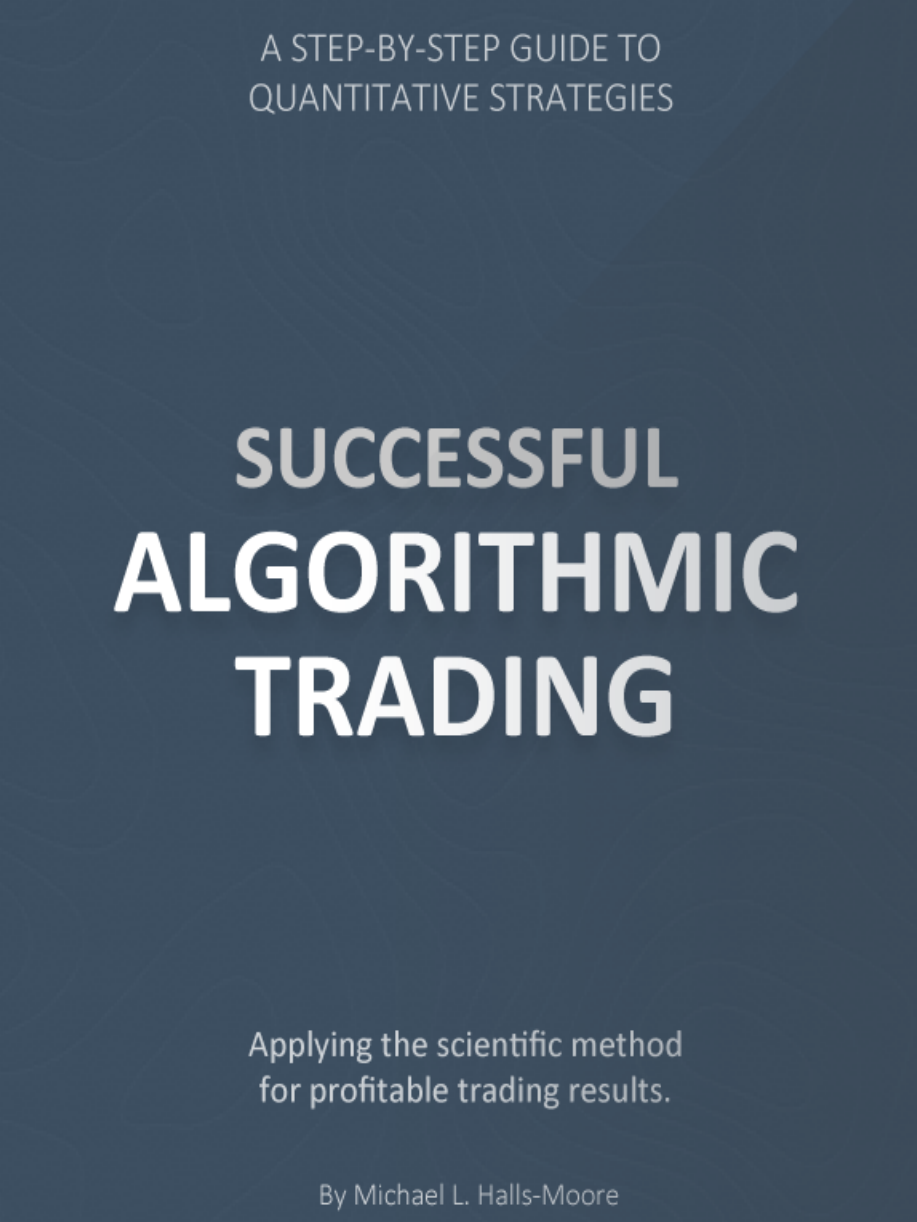
QuantStart was founded by Michael Halls-Moore, in 2010, to help junior quantitative analysts
(QAs) find jobs in the tough economic climate. Since then the site has evolved to become a
substantial resource for quantitative finance. The site now concentrates on algorithmic trading,
but also discusses quantitative development, in both Python and C++.
Since March 2010, QuantStart has helped over 200,000 visitors improve their quantitative
finance skills. You can always contact QuantStart by sending an email to mike@quantstart.com.
Successful Algorithmic Trading has been written to teach retail discretionary traders and trading
professionals, with basic programming skills, how to create fully automated profitable and robust
algorithmic trading systems using the Python programming language. The book describes the
nature of an algorithmic trading system, how to obtain and organise financial data, the concept of backtesting and how to implement an execution system. The book is designed to be
extremely practical, with liberal examples of Python code throughout the book to demonstrate
the principles and practice of algorithmic trading.
This book has been written for both retail traders and professional quants who have some basic
exposure to programming and wish to learn how to apply modern languages and libraries to
algorithmic trading. It is designed for those who enjoy self-study and can learn by example. The
book is aimed at individuals interested in actual programming and implementation, as I believe
that real success in algorithmic trading comes from fully understanding the implementation
details.
Professional quantitative traders will also find the content useful. Exposure to new libraries
and implementation methods may lead to more optimal execution or more accurate backtesting.
The book is relatively self-contained, but does assume a familiarity with the basics of trading in
a discretionary setting. The book does not require an extensive programming background, but
basic familiarity with a programming language is assumed. You should be aware of elementary
programming concepts such as variable declaration, flow-control (if-else) and looping (for/while).
Some of the trading strategies make use of statistical machine learning techniques. In addition, the portfolio/strategy optimisation sections make extensive use of search and optimization.
PDF Link - successful algorithmic trading halls-moore
Python Coding November 12, 2023 Books No comments
Deep learning is a fast-moving field with sweeping relevance in today’s increasingly digital world. Understanding Deep Learning provides an authoritative, accessible, and up-to-date treatment of the subject, covering all the key topics along with recent advances and cutting-edge concepts. Many deep learning texts are crowded with technical details that obscure fundamentals, but Simon Prince ruthlessly curates only the most important ideas to provide a high density of critical information in an intuitive and digestible form. From machine learning basics to advanced models, each concept is presented in lay terms and then detailed precisely in mathematical form and illustrated visually. The result is a lucid, self-contained textbook suitable for anyone with a basic background in applied mathematics.
Up-to-date treatment of deep learning covers cutting-edge topics not found in existing texts, such as transformers and diffusion models
Short, focused chapters progress in complexity, easing students into difficult concepts
Pragmatic approach straddling theory and practice gives readers the level of detail required to implement naive versions of models
Streamlined presentation separates critical ideas from background context and extraneous detail
Minimal mathematical prerequisites, extensive illustrations, and practice problems make challenging material widely accessible
Programming exercises offered in accompanying Python Notebooks
Python Coding November 12, 2023 Books No comments
Machine learning is one of the fastest growing areas of computer science, with far-reaching applications. The aim of this textbook is to introduce machine learning, and the algorithmic paradigms it offers, in a principled way. The book provides an extensive theoretical account of the fundamental ideas underlying machine learning and the mathematical derivations that transform these principles into practical algorithms. Following a presentation of the basics of the field, the book covers a wide array of central topics that have not been addressed by previous textbooks. These include a discussion of the computational complexity of learning and the concepts of convexity and stability; important algorithmic paradigms including stochastic gradient descent, neural networks, and structured output learning; and emerging theoretical concepts such as the PAC-Bayes approach and compression-based bounds. Designed for an advanced undergraduate or beginning graduate course, the text makes the fundamentals and algorithms of machine learning accessible to students and non-expert readers in statistics, computer science, mathematics, and engineering.
Buy - Understanding Machine Learning: From Theory to Algorithms
PDF Link - Understanding Machine Learning: From Theory to Algorithms
Python Coding November 11, 2023 Python No comments
import turtle
s = turtle.Screen()
t = turtle.Turtle()
def move_to(x,y):
t.penup()
t.goto(x,y)
t.pendown()
def draw_rectangle(a,b):
t.begin_fill()
t.forward(a)
t.left(90)
t.forward(b)
t.left(90)
t.forward(a)
t.left(90)
t.forward(b)
t.end_fill()
t.speed(10)
t.color("red")
move_to(-500,200)
draw_rectangle(10,100)
move_to(-490,250)
t.left(90)
draw_rectangle(80,10)
move_to(-410,200)
t.left(90)
draw_rectangle(10,100)
move_to(-380,200)
t.left(60)
t.color("yellow")
draw_rectangle(10,122)
move_to(-275,198)
t.left(145)
draw_rectangle(10,110)
move_to(-350,230)
t.left(335)
draw_rectangle(10,63)
move_to(-240,198)
t.left(270)
t.color("green")
draw_rectangle(100,10)
move_to(-240,288)
draw_rectangle(50,10)
move_to(-190,288)
draw_rectangle(40,10)
move_to(-190,248)
draw_rectangle(50,10)
move_to(-160,198)
t.color("violet")
draw_rectangle(100,10)
move_to(-160,288)
draw_rectangle(50,10)
move_to(-110,288)
draw_rectangle(40,10)
move_to(-110,248)
draw_rectangle(50,10)
move_to(-80,198)
t.left(320)
t.color("orange")
draw_rectangle(120,10)
move_to(-100,295)
draw_rectangle(68,10)
move_to(-500,80)
t.left(40)
t.color("blue")
draw_rectangle(100,10)
t.left(180)
move_to(-490,70)
draw_rectangle(50,10)
t.left(90)
t.fd(50)
t.right(90)
draw_rectangle(80,10)
t.left(90)
t.fd(80)
t.left(270)
draw_rectangle(50,10)
move_to(-400,80)
t.left(180)
t.color("pink")
draw_rectangle(100,10)
move_to(-220,70)
t.left(60)
t.color("brown")
draw_rectangle(100,10)
t.left(300)
move_to(-370,70)
t.right(152)
draw_rectangle(100,10)
t.left(152)
move_to(-290,10)
t.right(45)
draw_rectangle(40,10)
t.right(3)
draw_rectangle(40,10)
move_to(-200,-15)
t.left(200)
t.color("darkgreen")
draw_rectangle(10,110)
move_to(-95,-20)
t.left(145)
draw_rectangle(10,114)
move_to(-175,25)
t.left(333)
draw_rectangle(10,63)
move_to(-70,79)
t.left(90)
t.color("skyblue")
draw_rectangle(101,10)
move_to(-60,-22)
t.left(180)
draw_rectangle(80,10)
move_to(50,-22)
t.left(180)
t.color("black")
draw_rectangle(100,10)
move_to(300,150)
t.color("red")
angle=0
for i in range(20):
t.fd(50)
move_to(300,150)
angle+=18
t.left(angle)
move_to(450,150)
t.color("blue")
angle=0
for i in range(20):
t.fd(50)
angle+=18
t.left(angle)
move_to(450,150)
move_to(375,300)
t.color("green")
angle=0
for i in range(20):
t.fd(50)
angle+=18
t.left(angle)
move_to(375,300)
move_to(375,-300)
t.color("black")
angle=0
for i in range(20):
t.fd(50)
angle+=18
t.left(angle)
move_to(375,-300)
move_to(150,-150)
t.color("violet")
angle=0
for i in range(20):
t.fd(50)
angle+=18
t.left(angle)
move_to(150,-150)
move_to(450,-150)
t.color("brown")
angle=0
for i in range(20):
t.fd(50)
angle+=18
t.left(angle)
move_to(450,-150)
move_to(-200,-300)
t.color("green")
angle=0
for i in range(20):
t.fd(50)
angle+=18
t.left(angle)
move_to(-200,-300)
move_to(125,0)
t.color("yellow")
angle=0
for i in range(20):
t.fd(50)
angle+=18
t.left(angle)
move_to(125,0)
t.color("pink")
angle=0
move_to(-100,-200)
for i in range(20):
t.fd(50)
angle+=18
t.left(angle)
move_to(-100,-200)
t.color("lightgreen")
angle=0
move_to(300,0)
for i in range(20):
t.fd(50)
angle+=18
t.left(angle)
move_to(300,0)
t.color("skyblue")
angle=0
move_to(-500,-240)
for i in range(20):
t.fd(50)
angle+=18
t.left(angle)
move_to(-500,-240)
t.color("orange")
angle=0
move_to(-350,-170)
for i in range(20):
t.fd(50)
angle+=18
t.left(angle)
move_to(-350,-170)
t.color("black")
angle=0
move_to(500,20)
for i in range(20):
t.fd(50)
angle+=18
t.left(angle)
move_to(500,20)
#clcoding.com
Python Coding November 11, 2023 Projects No comments
Master data analysis and manipulation in Pandas and Python
Define and manipulate Pandas Series
Master Pandas Attributes, methods and math operations
Python Coding November 11, 2023 Python No comments
In Python, when you multiply a boolean value by an integer, the boolean value is implicitly converted to an integer. In this case, False is equivalent to 0, so False * 10 will result in 0.
If you run the following code: print(False * 10)
Python Coding November 11, 2023 Books No comments
Through a recent series of breakthroughs, deep learning has boosted the entire field of machine learning. Now, even programmers who know close to nothing about this technology can use simple, efficient tools to implement programs capable of learning from data. This bestselling book uses concrete examples, minimal theory, and production-ready Python frameworks (Scikit-Learn, Keras, and TensorFlow) to help you gain an intuitive understanding of the concepts and tools for building intelligent systems.
With this updated third edition, author Aurรฉlien Gรฉron explores a range of techniques, starting with simple linear regression and progressing to deep neural networks. Numerous code examples and exercises throughout the book help you apply what you've learned. Programming experience is all you need to get started.
Use Scikit-learn to track an example ML project end to end
Explore several models, including support vector machines, decision trees, random forests, and ensemble methods
Exploit unsupervised learning techniques such as dimensionality reduction, clustering, and anomaly detection
Dive into neural net architectures, including convolutional nets, recurrent nets, generative adversarial networks, autoencoders, diffusion models, and transformers
Use TensorFlow and Keras to build and train neural nets for computer vision, natural language processing, generative models, and deep reinforcement learning
PDF Link -
Python Coding November 11, 2023 Course, Python No comments
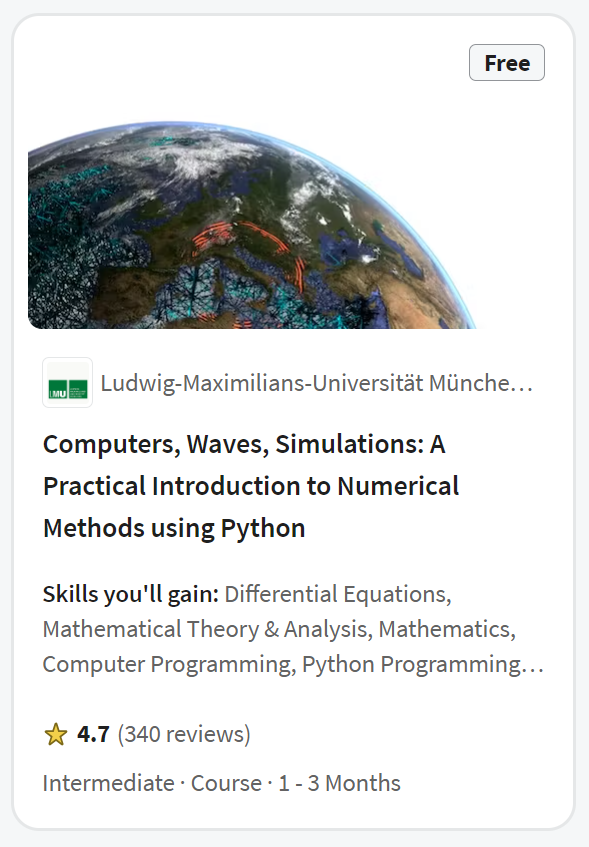
How to solve a partial differential equation using the finite-difference, the pseudospectral, or the linear (spectral) finite-element method.
Understanding the limits of explicit space-time simulations due to the stability criterion and spatial and temporal sampling requirements.
Strategies how to plan and setup sophisticated simulation tasks.
Strategies how to avoid errors in simulation results.
Interested in learning how to solve partial differential equations with numerical methods and how to turn them into python codes? This course provides you with a basic introduction how to apply methods like the finite-difference method, the pseudospectral method, the linear and spectral element method to the 1D (or 2D) scalar wave equation. The mathematical derivation of the computational algorithm is accompanied by python codes embedded in Jupyter notebooks. In a unique setup you can see how the mathematical equations are transformed to a computer code and the results visualized. The emphasis is on illustrating the fundamental mathematical ingredients of the various numerical methods (e.g., Taylor series, Fourier series, differentiation, function interpolation, numerical integration) and how they compare. You will be provided with strategies how to ensure your solutions are correct, for example benchmarking with analytical solutions or convergence tests. The mathematical aspects are complemented by a basic introduction to wave physics, discretization, meshes, parallel programming, computing models.
The course targets anyone who aims at developing or using numerical methods applied to partial differential equations and is seeking a practical introduction at a basic level. The methodologies discussed are widely used in natural sciences, engineering, as well as economics and other fields.
Python Coding November 11, 2023 Python No comments
#!/usr/bin/env python
# coding: utf-8
# # 20 extremely useful single-line Python codes
# # 1. Swap Variables:
# In[ ]:
a, b = b, a
# # 2. Find Maximum Element in a List:
# In[ ]:
max_element = max(lst)
# # 3. Find Minimum Element in a List:
# In[ ]:
min_element = min(lst)
# # 4. List Comprehension:
# In[ ]:
squared_numbers = [x**2 for x in range(10)]
# # 5. Filter List Elements:
# In[ ]:
even_numbers = list(filter(lambda x: x % 2 == 0, lst))
# # 6. Map Function:
# In[ ]:
doubled_numbers = list(map(lambda x: x * 2, lst))
# # 7. Sum of List Elements:
# In[ ]:
total = sum(lst)
# # 8. Check if All Elements in a List are True:
# In[ ]:
all_true = all(lst)
# # 9. Check if Any Element in a List is True:
# In[ ]:
any_true = any(lst)
# # 10. Count Occurrences of an Element in a List:
# In[ ]:
count = lst.count(element)
# # 11. Reverse a String:
# In[ ]:
reversed_str = my_str[::-1]
# # 12. Read a File into a List of Lines:
# In[ ]:
lines = [line.strip() for line in open('file.txt')]
# # 13. Inline If-Else:
# In[ ]:
result = "even" if x % 2 == 0 else "odd"
# # 14. Flatten a Nested List:
# In[ ]:
flat_list = [item for sublist in nested_list for item in sublist]
# # 15. Find the Factorial of a Number:
# In[ ]:
factorial = 1 if n == 0 else functools.reduce(lambda x, y: x * y, range(1, n+1))
# # 16. List Unique Elements:
# In[ ]:
unique_elements = list(set(lst))
# # 17. Execute a Function for Each Element in a List:
# In[ ]:
result = list(map(lambda x: my_function(x), lst))
# # 18. Calculate the Average of a List:
# In[ ]:
average = sum(lst) / len(lst) if len(lst) > 0 else 0
# # 19. Convert a String to a List of Characters:
# In[ ]:
char_list = list("hello")
# # 20. Find Common Elements Between Two Lists:
# In[ ]:
common_elements = list(set(lst1) & set(lst2))
# In[ ]:
Python Coding November 10, 2023 Python No comments
Stacks and queues are fundamental data structures used in computer science to manage and organize data. Let's get started with stacks and queues in Python.
A stack is a Last In, First Out (LIFO) data structure, where the last element added is the first one to be removed. Think of it like a stack of plates - you can only take the top plate off.
Python Coding November 10, 2023 Course, Python No comments
Install Python and write your first program
Describe the basics of the Python programming language
Use variables to store, retrieve and calculate information
Utilize core programming tools such as functions and loops
This course aims to teach everyone the basics of programming computers using Python. We cover the basics of how one constructs a program from a series of simple instructions in Python. The course has no pre-requisites and avoids all but the simplest mathematics. Anyone with moderate computer experience should be able to master the materials in this course. This course will cover Chapters 1-5 of the textbook “Python for Everybody”. Once a student completes this course, they will be ready to take more advanced programming courses. This course covers Python 3.
Python Coding November 10, 2023 Python No comments
def add(a, b):
return a + 5 , b + 5
print(add(10,11))
The add function takes two parameters, a and b, and returns a tuple where the first element is the sum of a + 5 and the second element is b + 5.
When you call add(10, 11), it will return a tuple where the first element is 10 + 5 (which is 15) and the second element is 11 + 5 (which is 16). Therefore, the output of print(add(10, 11)) will be: (15, 16)
Python Coding November 09, 2023 Course No comments
How to train and develop an image classification system using machine learning
How to train and develop an object detection system using machine learning
How to deploy a machine learning model to a microcontroller
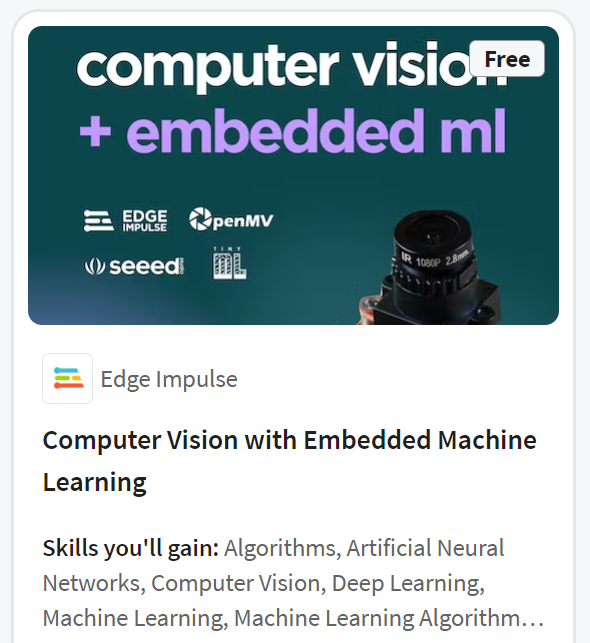
Computer vision (CV) is a fascinating field of study that attempts to automate the process of assigning meaning to digital images or videos. In other words, we are helping computers see and understand the world around us! A number of machine learning (ML) algorithms and techniques can be used to accomplish CV tasks, and as ML becomes faster and more efficient, we can deploy these techniques to embedded systems.
This course, offered by a partnership among Edge Impulse, OpenMV, Seeed Studio, and the TinyML Foundation, will give you an understanding of how deep learning with neural networks can be used to classify images and detect objects in images and videos. You will have the opportunity to deploy these machine learning models to embedded systems, which is known as embedded machine learning or TinyML.
Familiarity with the Python programming language and basic ML concepts (such as neural networks, training, inference, and evaluation) is advised to understand some topics as well as complete the projects. Some math (reading plots, arithmetic, algebra) is also required for quizzes and projects. If you have not done so already, taking the "Introduction to Embedded Machine Learning" course is recommended.
This course covers the concepts and vocabulary necessary to understand how convolutional neural networks (CNNs) operate, and it covers how to use them to classify images and detect objects. The hands-on projects will give you the opportunity to train your own CNNs and deploy them to a microcontroller and/or single board computer.
Python Coding November 09, 2023 Python No comments
The above code counts the total number of unique characters in the given strings. Here's the breakdown:
Create an empty set s:
s = set()
This line initializes an empty set s.
Update the set with multiple string arguments using the update method:
s.update('hello', 'how', 'are', 'you?')
In this line, you're using the update method to add the characters from the strings 'hello', 'how', 'are', and 'you?' to the set s.
Print the length of the set:
print(len(s))
This line prints the length (number of elements) of the set s using the len function. Since each character is considered unique, the length will be the total number of unique characters in the combined strings.
The output will be 10 because it counts the total number of unique characters in the provided strings. Thank you for pointing this out.
Python Coding November 08, 2023 Python No comments
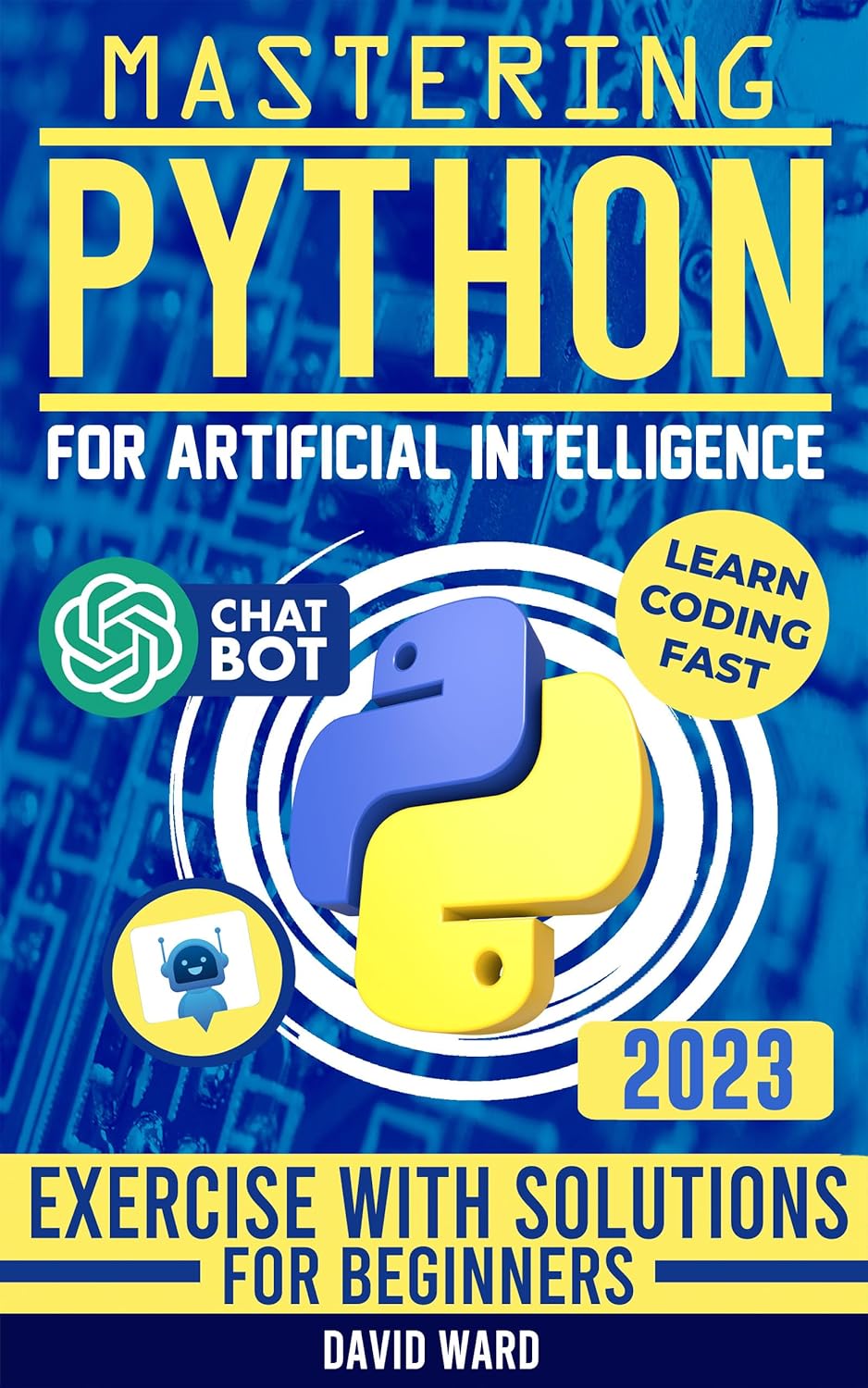
Are you fascinated by the possibilities of Artificial Intelligence but feel limited by your current coding skills? Do you dream of creating advanced AI applications but need help finding the right resources?
Look no further! "Mastering Python for Artificial Intelligence" is your gateway to learning the essential coding skills that will empower you to build cutting-edge AI applications.
Whether you're a beginner or an experienced programmer, this book will guide you through Python's intricacies and equip you with the knowledge to unleash the true potential of AI.
Mastering Python for Artificial Intelligence" offers an innovative approach encompassing three well-defined principles, ensuring an empowering learning journey for readers.
1. Practicality: The book strongly believes in the value of learning by doing. Unlike many other resources, "Mastering Python for Artificial Intelligence" immediately provides the outputs of ALL the examples. Readers won't have to wait to test the code on their computers or wonder if they are on the right track. This practical approach ensures hands-on experience, reinforcing knowledge and boosting confidence.
2. Simplicity: Learning complex subjects should be approached step by step, and "Mastering Python for Artificial Intelligence" embraces this principle. Each concept is broken down into simple and easily digestible steps. The book aims to make learning efficient and enjoyable, allowing readers to grasp a multitude of topics in the shortest possible time. Clear explanations and examples accompany the content, ensuring rapid progress and understanding.
3. Synthesis: Recognizing that starting with Python can be overwhelming, this book takes a thoughtful approach. Carefully selected topics provide a comprehensive introduction to Python, offering a solid foundation without overwhelming the reader. By presenting essential concepts in a structured manner, the book ensures broad exposure to Python and its applications in Artificial Intelligence.
Here's a sneak peek into what you'll discover:
• Gain a solid understanding of Python's notable features and why it is the preferred language for AI development.
• Learn the step-by-step process of Python IDE installation, ensuring you have the optimal environment for AI programming.
• Explore Python programming fundamentals, including variables, statements, operators, and flow control, laying the groundwork for AI development.
• Dive into the world of data types, such as numeric, sequence, string, list, tuple, set, and dictionary, and understand how they play a crucial role in AI applications.
• Unleash the potential of Python classes and objects and understand how they form the building blocks of AI models and algorithms.
• Discover the wealth of Python libraries and frameworks available for AI development, such as TensorFlow, Keras, scikit-learn, and more.
• Learn how to preprocess data, train AI models, and evaluate their performance using Python's powerful AI libraries.
• Get hands-on experience with practical coding examples and exercises, allowing you to apply your newfound knowledge and solidify your skills.
• The SOLUTIONS to the exercises (but be sure to look at them only after first trying to solve the exercises on your own)
• BONUS: EMPOWERING YOUR LIFE: Harnessing the Power of Chat GPT and Python to Create Your Personal Assistant (scan the QR code inside the book)
Python Coding November 07, 2023 Python No comments
l=[1, 0, 2, 0, 'hello', '', []]
print(list(filter(bool, l)))
Step 1: Define a list l with various elements:
l = [1, 0, 2, 0, 'hello', '', []]
This list contains a mix of integers, strings, an empty string, and an empty list.
Step 2: Use the filter() function with bool as the filtering function:
filtered_list = filter(bool, l)
In this step, the filter() function is applied to the list l. The bool function is used as the filtering function. The bool function converts each element of the list into a Boolean value (True or False) based on its truthiness. Elements that evaluate to True are kept, and elements that evaluate to False are removed.
Step 3: Convert the filtered result into a list:
filtered_list = list(filtered_list)
The filter function returns an iterator, so to get the final result as a list, we use the list() constructor to convert the filtered result into a list.
Step 4: Print the filtered list:
print(filtered_list)
This line prints the filtered list to the console.
Step 5: The output is as follows:
[1, 2, 'hello']
In the filtered list, all elements that evaluate to False (0, empty string, and empty list) have been removed. The resulting list contains only the elements that are considered "truthy" according to Python's boolean conversion rules.
Python Coding November 07, 2023 Python No comments
Identify a subset of data needed from a column or set of columns and write a SQL query to limit to those results.
Use SQL commands to filter, sort, and summarize data.
Create an analysis table from multiple queries using the UNION operator.
Manipulate strings, dates, & numeric data using functions to integrate data from different sources into fields with the correct format for analysis.
As data collection has increased exponentially, so has the need for people skilled at using and interacting with data; to be able to think critically, and provide insights to make better decisions and optimize their businesses. This is a data scientist, “part mathematician, part computer scientist, and part trend spotter” (SAS Institute, Inc.). According to Glassdoor, being a data scientist is the best job in America; with a median base salary of $110,000 and thousands of job openings at a time. The skills necessary to be a good data scientist include being able to retrieve and work with data, and to do that you need to be well versed in SQL, the standard language for communicating with database systems.
This course is designed to give you a primer in the fundamentals of SQL and working with data so that you can begin analyzing it for data science purposes. You will begin to ask the right questions and come up with good answers to deliver valuable insights for your organization. This course starts with the basics and assumes you do not have any knowledge or skills in SQL. It will build on that foundation and gradually have you write both simple and complex queries to help you select data from tables. You'll start to work with different types of data like strings and numbers and discuss methods to filter and pare down your results.
You will create new tables and be able to move data into them. You will learn common operators and how to combine the data. You will use case statements and concepts like data governance and profiling. You will discuss topics on data, and practice using real-world programming assignments. You will interpret the structure, meaning, and relationships in source data and use SQL as a professional to shape your data for targeted analysis purposes.
Although we do not have any specific prerequisites or software requirements to take this course, a simple text editor is recommended for the final project. So what are you waiting for? This is your first step in landing a job in the best occupation in the US and soon the world!
Python Coding November 07, 2023 Course, MICHIGAN No comments
Learn to Program and Analyze Data with Python. Develop programs to gather, clean, analyze, and visualize data.
Specialization - 5 course series
This Specialization builds on the success of the Python for Everybody course and will introduce fundamental programming concepts including data structures, networked application program interfaces, and databases, using the Python programming language. In the Capstone Project, you’ll use the technologies learned throughout the Specialization to design and create your own applications for data retrieval, processing, and visualization.
Python Coding November 07, 2023 Python No comments
Welcome to Introduction to Python! Here's an overview of the course.
Familiarize yourself with the building blocks of Python! Learn about data types and operators, built-in functions, type conversion, whitespace, and style guidelines.
Use data structures to order and group different data types together! Learn about the types of data structures in Python, along with more useful built-in functions and operators.
Build logic into your code with control flow tools! Learn about conditional statements, repeating code with loops and useful built-in functions, and list comprehension
Learn how to use functions to improve and reuse your code! Learn about functions, variable scope, documentation, lambda expressions, iterators, and generators.
Setup your own programming environment to write and run Python scripts locally! Learn good scripting practices, interact with different inputs, and discover awesome tools.
In this lesson we cover some advanced topics of iterators and generators. You are not required to complete this but we have provided these to give you a taste of these.
Python Coding November 06, 2023 Python No comments
The code will correctly generate a list of lambda functions that multiply a given value x by the corresponding value of i from the range (0, 1, 2, 3) and then call each of these lambda functions with the argument 2. The correct output will be:
[0, 2, 4, 6]
Here's how it works:
The multipliers function returns a list of lambda functions where each lambda function takes two arguments, x and i. The default argument i=i captures the current value of i from the loop when the lambda function is created.
The list comprehension [m(2) for m in multipliers()] iterates through each lambda function created in the multipliers list and calls it with 2 as the argument. Each lambda function multiplies 2 by its respective i value from the range, resulting in the output [0, 2, 4, 6].
Python Coding November 06, 2023 Books, Python No comments
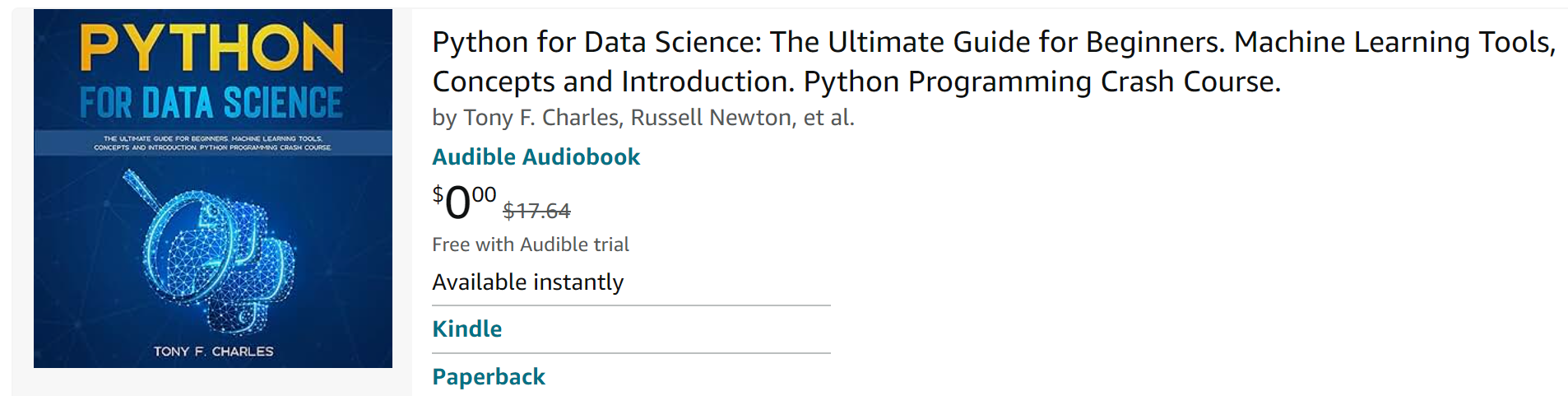
Are you looking for an ultimate python step-by step guide in an efficient way? Do you want to implement a variety of supervised and unsupervised learning algorithms and techniques quickly and accurately?
If you cannot wait to explore the fundamental concepts and entire process on python data science, listen to this audiobook!
You will start by learning the basics of working with Python and the wide variety of data science packages and extensions. You will be guided on how to setup you work environment before diving into the world of data science. In each section you will learn a great deal of theory backed up by practical examples that contain well-explained Python code. Once you have the fundamentals down, you will get to the core of data science learning algorithms and techniques that are industry-standard in this field.
Studying data science and working with supervised and unsupervised algorithms, as well as neural networks, doesn’t have to be as complicated as it sounds. Explore the world of data science using clear, simple, real-world examples and enjoy the power and versatility of Python and machine learning algorithms!
Python Coding November 06, 2023 Course, Python No comments
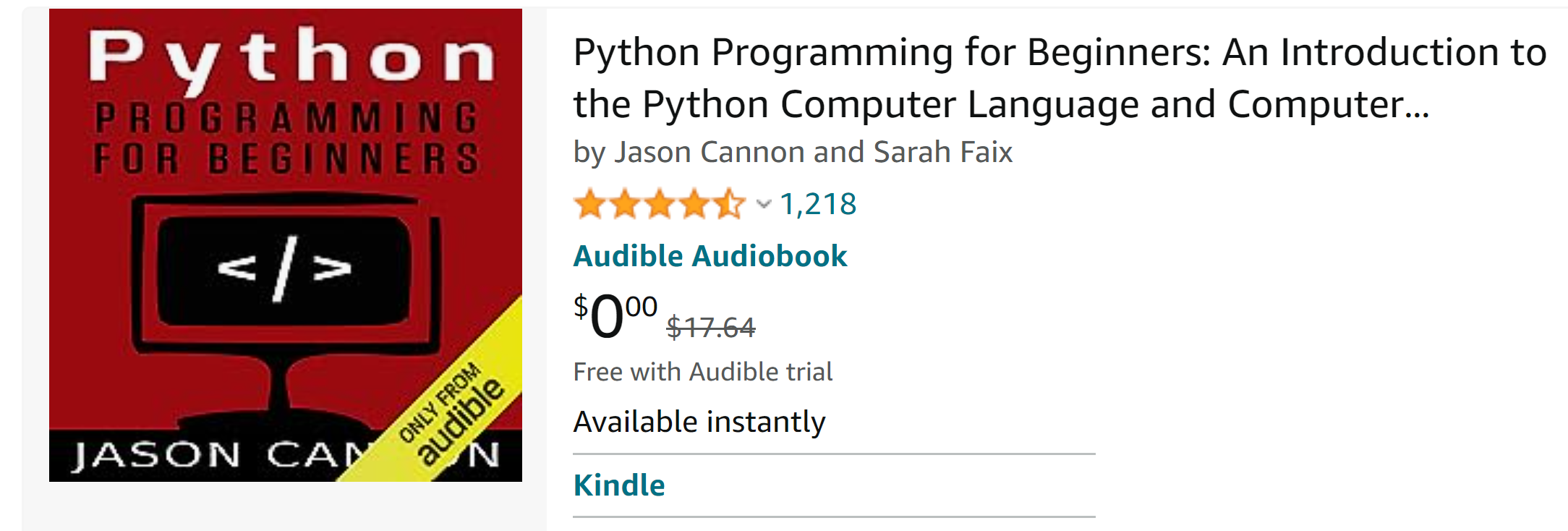
If you want to learn how to program in Python, but don't know where to start read on.
Knowing where to start when learning a new skill can be a challenge, especially when the topic seems so vast. There can be so much information available that you can't even decide where to start. Or worse, you start down the path of learning and quickly discover too many concepts, commands, and nuances that aren't explained. This kind of experience is frustrating and leaves you with more questions than answers.
Python Programming for Beginners doesn't make any assumptions about your background or knowledge of Python or computer programming. You need no prior knowledge to benefit from this book. You will be guided step by step using a logical and systematic approach. As new concepts, commands, or jargon are encountered they are explained in plain language, making it easy for anyone to understand.
Here is what you will learn by listening to Python Programming for Beginners:
Python Coding November 06, 2023 Books, Python No comments
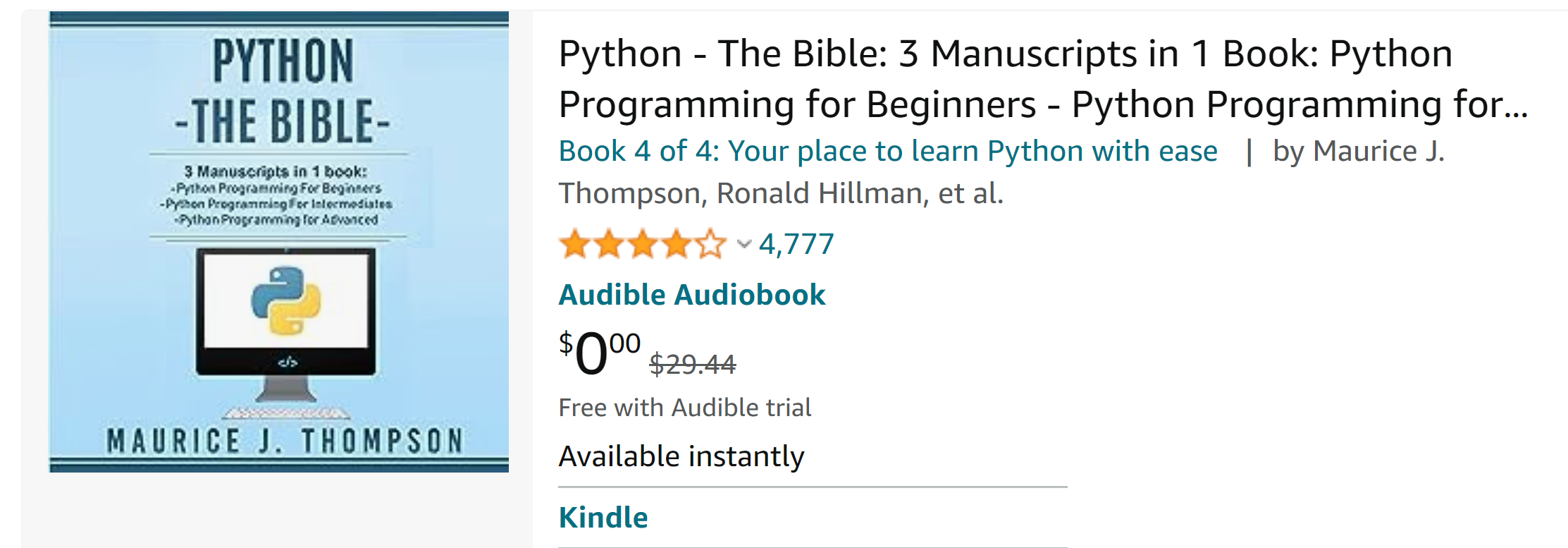
Python Programming for Beginners - Learn the Basics of Python in 7 Days!
Here's what you'll learn from this book:
Python Coding November 05, 2023 Python No comments
In the above code a tuple named cl that contains a single element, the string 'a'. Tuples are defined by placing a comma-separated sequence of values within parentheses. In this case, you have a single value 'a' enclosed in parentheses.
When you print cl, you will get the following output:
('a',)
The trailing comma after 'a' is optional but commonly included in tuples with a single element to distinguish them from regular parentheses. It doesn't affect the tuple's behavior but is a convention used to define one-element tuples.
Python Coding November 05, 2023 Course, Python No comments
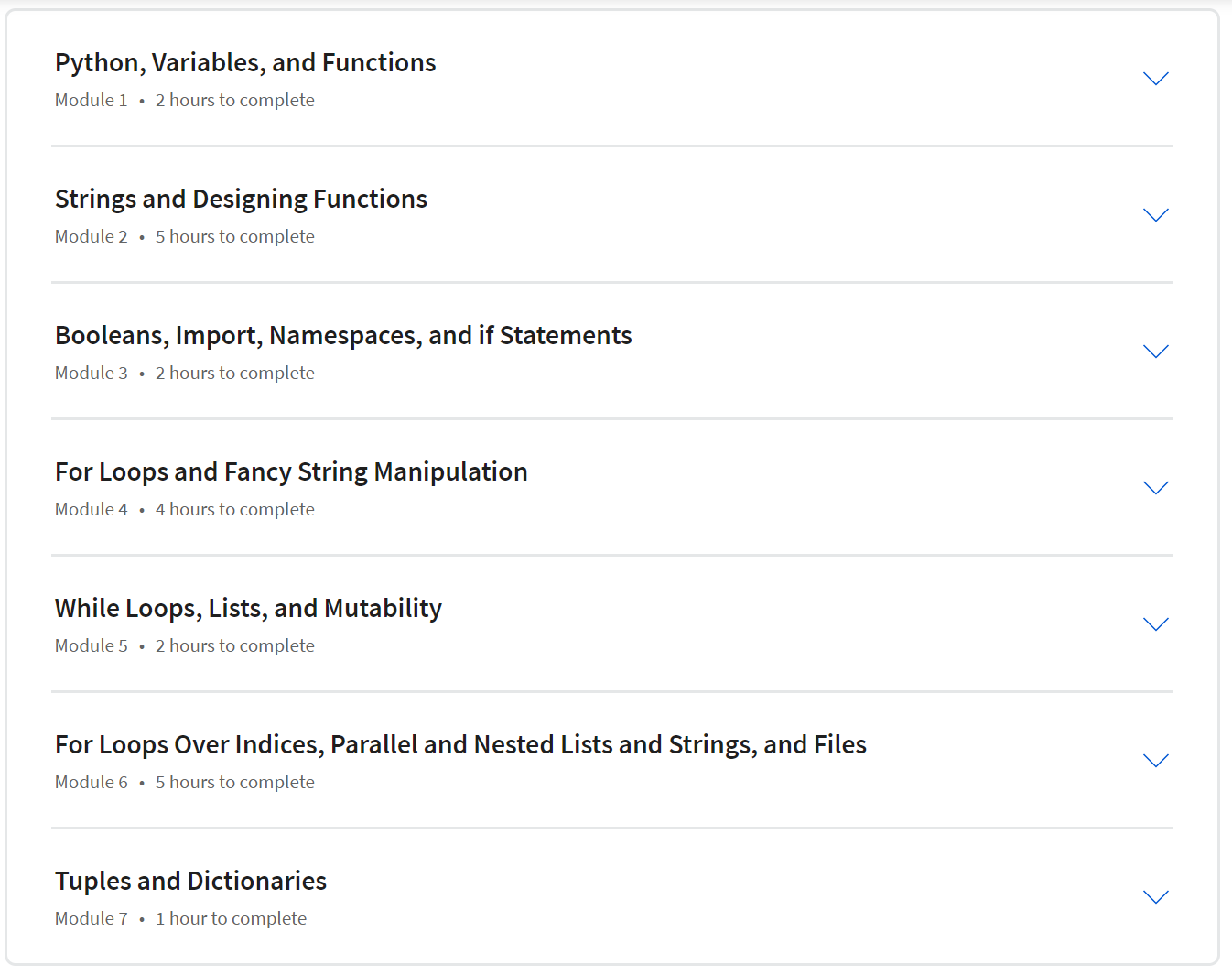
There are 7 modules in this course
Behind every mouse click and touch-screen tap, there is a computer program that makes things happen. This course introduces the fundamental building blocks of programming and teaches you how to write fun and useful programs using the Python language.
This module gives an overview of the course, the editor we will use to write programs, and an introduction to fundamental concepts in Python including variables, mathematical expressions, and functions.
Python Coding November 04, 2023 Python No comments
The above code creates two lists a and b, each containing a single element with the value 10. When you use the is operator to compare a and b, it checks if they are the same object in memory. In this case, the two lists are not the same object, even though their contents are the same, so a is b will return False`. Here's the code and the result:
a = [10]
b = [10]
print(a is b) # This will print False
Even though the values in a and b are the same, they are different objects in memory, so the is comparison returns False. If you want to check if the contents of the lists are equal, you should use the == operator:
a = [10]
b = [10]
print(a == b) # This will print True
Python Coding November 04, 2023 Python No comments
x=[1,2,3] ; y=[1,2,3]
x==y
x is y
In Python, when you use the == operator, it checks if the values of the two variables are equal. So, when you do x == y, it will return True because the values of x and y are the same: both lists contain the same elements in the same order.
However, when you use the is operator, it checks if two variables refer to the same object in memory. In your example, x is y will return False because even though the values of x and y are the same, they are two different list objects in memory. This is because lists are mutable objects in Python, and the x and y variables refer to two separate list objects that happen to have the same values.
x=[1,2,3] ; y=[1,2,3]
x=y
x is y
In this case, when you do x = y, you are assigning the variable x to refer to the same list object that y is referring to. As a result, x and y now both point to the same list object in memory. So, when you check x is y, it will return True because they are indeed the same object in memory.
Here's what happens step by step:
x and y are initially two separate list objects with the same values: [1, 2, 3].
When you do x = y, you're essentially making x reference the same list object as y. Now, both x and y point to the same list object.
Therefore, when you check x is y, it returns True because they are the same object in memory.
Keep in mind that this behavior is specific to mutable objects like lists in Python. For immutable objects like integers or strings, x is y would return True if x and y have the same value, because Python caches some immutable objects, and they can be shared among variables.
Python Coding November 04, 2023 Python No comments
def binary_search(arr, target):
left, right = 0, len(arr) - 1
while left <= right:
mid = (left + right) // 2
if arr[mid] == target:
return mid # Found the target, return its index
elif arr[mid] < target:
left = mid + 1 # Target is in the right half
else:
right = mid - 1 # Target is in the left half
return -1 # Target is not in the list
# Example usage:
arr = [1, 2, 3, 4, 5, 6, 7, 8, 9, 10]
target = 6
result = binary_search(arr, target)
if result != -1:
print(f"Element {target} found at index {result}")
else:
print(f"Element {target} not found in the list")
#clcoding.com
Python Coding November 04, 2023 Python No comments
This course covers the basics of the Python programming language, and is targeted to students who have no programming experience. The course begins by establishing a strong foundation in basic programming concepts. Through engaging lessons and practical exercises, students will master essential topics such as variables, relational and boolean operators, control statements, and input/output operations. Building on this solid groundwork, students will program with functions, lists, and tuples. In the final phase of the course, students will unlock the full potential of Python by harnessing the capabilities of the popular NumPy library.
The course will illustrate how Python is utilized in the exciting field of business analytics through real-world examples and hands-on exercises. With an emphasis on interactivity, students will code alongside the course materials. By the end of this course, students will have developed a strong understanding of programming principles, gained proficiency in Python syntax, and developed the skill to apply Python functions to basic analytic problems.
Upon completion of this course, students should be able to:
1. Install and use the Anaconda distribution of Python through the creation of Jupyter notebooks.
2. Understand and use variables in Python
3. Work with common Python data types including float, integer, string, boolean, lists, and tuples
4. Create expression in Python with variables, relational operators, and boolean operators
5. Implement basic program flow control with if statements and loops
6. Read data from and write data to text files.
7. Utliize important analytic libraries like Numpy
8. Understand how to implement and adequately test algorithms in Python
Join free - Python Fundamentals for Business Analytics
Python Coding November 04, 2023 C, C++ No comments
Beginner to Programmer — Learn to Code in C & C++. Gain a deep understanding of computer programming by learning to code, debug, and solve complex problems with C and C++.
Write and debug code in C and C++ programming languages
Understand algorithms, and how to properly express them
This Specialization is intended for all programming enthusiasts, as well as beginners, computer and other scientists, and artificial intelligence enthusiasts seeking to develop their programming skills in the foundational languages of C and C++. Through the four courses — two in C, and two in C++ — you will cover the basics of programming in C and move on to the more advanced C++ semantics and syntax, which will prepare you to apply these skills to a number of higher-level problems using AI algorithms and Monte Carlo evaluation in complex games.
Applied Learning Project
Learners in this specialization will start coding right from the start. Every module presents ample opportunities for writing programs and finding errors in the learner's own and others' code. Building on their knowledge, learners will demonstrate their understanding of coding in a practice-intensive final assessment.
Python Coding November 03, 2023 Python No comments
The code does step by step:
s is defined as a set containing the elements {1, 2, 3, 4, 1}. Note that sets in Python are unordered collections of unique elements, so any duplicate elements are automatically removed.
The s.discard(0) line attempts to remove the element 0 from the set s using the discard method.
However, since 0 is not in the set s, calling discard(0) has no effect.
Finally, the print(s) statement prints the contents of the set s after attempting to discard 0. The output will be: {1, 2, 3, 4}.
The discard method is used to safely remove an element from a set if it exists, but it won't raise an error if the element is not present in the set. In contrast, the remove method would raise a KeyError if you try to remove an element that is not in the set.
Python Coding November 03, 2023 Python No comments
Pandas is a powerful library for data manipulation and analysis in Python. To ensure consistent and reliable results when using Pandas, consider the following best practices:
Import Pandas Properly: Import Pandas at the beginning of your script or notebook, and use a common alias like import pandas as pd. This makes your code more readable and consistent across projects.
Use Explicit Data Types: When reading data with read_csv, read_excel, or other methods, specify the data types for columns using the dtype parameter. This ensures that Pandas doesn't infer data types incorrectly.
Handle Missing Data: Use appropriate methods like isna(), fillna(), or dropna() to deal with missing data. Be consistent in your approach to handling missing values throughout your analysis.
Consistent Naming Conventions: Use consistent naming conventions for your variables and DataFrame columns. This makes your code more readable and reduces the chance of errors.
Indexing and Selection: Use loc and iloc for explicit and consistent DataFrame indexing. Avoid using chained indexing, as it can lead to unpredictable results.
Method Chaining: Consider using method chaining to perform a sequence of Pandas operations on a DataFrame. This makes your code more concise and readable. Libraries like pandas-flavor and pipe can help with this.
Avoid SettingWithCopyWarning: When creating new DataFrames or manipulating existing ones, avoid using chained assignment. Instead, use copy() to ensure that you work on a copy of the data and not a view, which can lead to unexpected behavior.
Documentation and Comments: Provide documentation and comments in your code to explain the purpose and steps of your data analysis. This helps others understand your code and ensures consistency in your own work.
Testing and Validation: Write unit tests to validate the correctness of your data processing steps. Consistent testing can help catch errors early and maintain reliable results.
Version Control: Use version control tools like Git to keep track of changes in your code and data. This helps maintain consistency when working on projects with a team or over time.
Data Type Awareness: Be aware of data types and their impact on operations. For example, dividing integers in Pandas will result in integer division, which may not be what you expect. Use appropriate casting or conversion to handle data types correctly.
Use Vectorized Operations: Take advantage of Pandas' built-in vectorized operations whenever possible. They are more efficient and lead to consistent results.
Avoid Global Variables: Minimize the use of global variables in your code. Instead, encapsulate your operations in functions to ensure consistent behavior.
Upgrade Pandas: Keep your Pandas library up to date to benefit from bug fixes and improvements. However, be aware that upgrading may require adjustments in your code to maintain consistency.
By following these best practices, you can ensure that your data analysis with Pandas is more consistent, maintainable, and less prone to errors. Consistency in coding practices also helps in collaboration with others and simplifies debugging and troubleshooting.
Python Coding November 03, 2023 Books No comments
What's inside this 301 page book?
201 real Data Science interview questions asked by Facebook, Google, Amazon, Netflix, Two Sigma, Citadel and more — with detailed step-by-step solutions!
Learn how to break into Data Science, with tips on crafting your resume, creating kick-ass portfolio projects, sending networking cold emails, and better telling your story during behavioral interviews
Questions cover the most frequently-tested topics in data interviews: Probability, Statistics, Machine Learning, SQL & Database Design, Coding (Python), Product Analytics, and A/B Testing
Each chapter has a brief crash-course on the most important concepts and formulas to review
Learn how to solve open-ended case study questions that combine product-sense, business intuition, and statistical modeling skills, and practice with case interviews from Airbnb, Instagram, & Accenture
Python Coding November 03, 2023 Google, Python No comments
Use Python external libraries to create and modify documents, images, and messages
Understand and use Application Programming Interfaces (APIs) to interact with web services
Understand and use data serialization to send messages between running programs
Build a solution using the skills you have learned
In the final course, we'll tie together the concepts that you’ve learned up until now. You'll tackle real-world scenarios in Qwiklabs that will challenge you to use multiple skills at once.
First, we'll take a closer look at how to use external Python modules to extend your code's capabilities, and spend some time learning how to use documentation to learn a new module. For example, we'll use the Python Image Library (PIL) to create and modify images. We'll show you some simple examples of how to perform common tasks in the course material, but it will be up to you to explore the module documentation to figure out how to solve specific problems.
Next, we'll show you how to communicate with the world outside of your code! You'll use data serialization to turn in-memory objects into messages that can be sent to other programs. Your program will send messages across the network to Application Programming Interfaces (APIs) offered by other programs. For those times when your code needs to talk to a person instead of a program, you'll also learn to send email messages.
At the end of this course, you’ll be able to take a description of a problem and use your skills to create a solution -- just like you would on the job. In your final capstone project, you'll be given a description of what your customer needs, and it will be up to you to create a program to do it!
Python Coding November 03, 2023 Course, Projects No comments
In this 1-hour long project-based course, you will learn how to create a basic single-player Pong replica using the PyGame library for Python, creating a welcome screen, a game that responds to user input to move the paddle, scoring, and a game over screen with user options. By the end of the course, learners will have a basic understanding of the PyGame library and will be able to create simple games built on shapes. No previous experience with PyGame is required, as this is a basic introduction to the library, but familiarity with Python is recommended.
Note: This course works best for learners who are based in the North America region. We’re currently working on providing the same experience in other regions.
In a video that plays in a split-screen with your work area, your instructor will walk you through these steps:
Create the display and the ball
Add motion to the ball and a paddle
Detect collisions and create a Game Over screen
Expand game play options
Reset the game to continue play
Scorekeeping, randomizing, and expansion options
Python Coding November 03, 2023 Python No comments
Understand how text is handled in Python
Apply basic natural language processing methods
Write code that groups documents by topic
Describe the nltk framework for manipulating text
This course will introduce the learner to text mining and text manipulation basics. The course begins with an understanding of how text is handled by python, the structure of text both to the machine and to humans, and an overview of the nltk framework for manipulating text. The second week focuses on common manipulation needs, including regular expressions (searching for text), cleaning text, and preparing text for use by machine learning processes. The third week will apply basic natural language processing methods to text, and demonstrate how text classification is accomplished. The final week will explore more advanced methods for detecting the topics in documents and grouping them by similarity (topic modelling).
Python Coding November 03, 2023 Course, Data Science No comments
Play the role of a Data Scientist / Data Analyst working on a real project.
Demonstrate your Skills in Python - the language of choice for Data Science and Data Analysis.
Apply Python fundamentals, Python data structures, and working with data in Python.
Build a dashboard using Python and libraries like Pandas, Beautiful Soup and Plotly using Jupyter notebook.
This mini-course is intended to for you to demonstrate foundational Python skills for working with data. This course primarily involves completing a project in which you will assume the role of a Data Scientist or a Data Analyst and be provided with a real-world data set and a real-world inspired scenario to identify patterns and trends.
You will perform specific data science and data analytics tasks such as extracting data, web scraping, visualizing data and creating a dashboard. This project will showcase your proficiency with Python and using libraries such as Pandas and Beautiful Soup within a Jupyter Notebook. Upon completion you will have an impressive project to add to your job portfolio.
PRE-REQUISITE: **Python for Data Science, AI and Development** course from IBM is a pre-requisite for this project course. Please ensure that before taking this course you have either completed the Python for Data Science, AI and Development course from IBM or have equivalent proficiency in working with Python and data.
NOTE: This course is not intended to teach you Python and does not have too much instructional content. It is intended for you to apply prior Python knowledge.
Python Coding November 02, 2023 Python No comments
In the above code a function add(a, b) that takes two arguments a and b and returns their sum using the + operator. However, there's a potential issue because you are trying to add an integer (3) and a string ('2') together, which can lead to a type error.
When you call add(3, '2'), the function is trying to add an integer and a string, which is not a valid operation in Python. Python typically doesn't allow you to perform arithmetic operations between different data types without explicit type conversion.
Free Books Python Programming for Beginnershttps://t.co/uzyTwE2B9O
— Python Coding (@clcoding) September 11, 2023
Top 10 Python Data Science book
— Python Coding (@clcoding) July 9, 2023
๐งต:
Top 4 free Mathematics course for Data Science ! pic.twitter.com/s5qYPLm2lY
— Python Coding (@clcoding) April 26, 2024
Web Development using Python
— Python Coding (@clcoding) December 2, 2023
๐งต: